
Agent Readiness
Agent Readiness: is your product data ready for AI shopping channels?
Agent Readiness is an explainer and checklist for a named machine-facing channel; it gives no score and human approval stays. The Youzu checklist asks whether product and offer information suits that channel, such as a shopping assistant, and describes readiness across 9 layers in 3 bands.
What the self-check covers
Whether your product and offer information suits one named channel, such as a shopping assistant.
- One named channel at a time
- 9 layers in 3 descriptive bands
- Human review keeps the approval gate
3 ideas
3 ideas behind readiness.
Prepare the record.
Make a product's identity and supported attributes understandable and reusable.
Keep the offer distinct.
Price, availability and seller commitments belong to the relevant offer and need an authoritative source.
Define the action.
A useful product response and permission to change an order or publish a listing are different capabilities; any action-taking integration needs its own scope and controls.
Destinations
One record, 4 places that read it.
Clear, consistent product facts give search engines and shopping assistants better material to work with.
Choose a destination to see which fields of the record it reads.

Product record
Stainless steel kettle
Identity
- Title
- Stainless steel kettle
- GTIN
- 2001234500005
Category
- Category
- Kitchen › Small appliances › Kettles
Attributes
- Color
- Silver
- Material
- Stainless steel
- Capacity
- 1.7 l
- Power
- 2200 W
- Cordless
- Yes
- Auto shut-off
- Yes
Description
- Description
- Cordless kettle with a brushed stainless steel body, a 1.7 l capacity and automatic shut-off.
Offer
- Availability
- In stock
- Condition
- New
Read as text
Agent Readiness is an explainer and checklist for whether product and offer information suits a named machine-facing channel; it gives no score and human approval stays.
Self-check
Check one record against one channel.
Mark the layers you can show for one product record and one named channel.
Optional.
This is a checklist, not a score. It describes what is in place today for one named channel. It makes no prediction about commercial results.
Machine-readable
Not startedExample
- In place looks like
- The full jacket record can be read as structured data through an API or a feed, without scraping the product page.
- A typical gap
- The record exists only as text on a page.
- First step
- Expose the record through a feed or API that your team can document.
Example
- In place looks like
- The olive jacket in size M keeps one identifier in your feed, your PIM and your listing.
- A typical gap
- The identifier changes when the supplier file is re-sent.
- First step
- Pick one identifier per variant and send it every time.
Example
- In place looks like
- Color: Olive, Material: Cotton and Closure: Buttons are separate typed fields.
- A typical gap
- Color and material sit inside the title.
- First step
- Move facts out of titles into the fields your category defines.
Governed
Not startedExample
- In place looks like
- 3 colors and 3 sizes sit under one jacket as variants, not as unrelated listings.
- A typical gap
- Sizes are written in the description.
- First step
- Model variants explicitly and link them to one product.
Example
- In place looks like
- Each seller's price and availability sit on that seller's offer, with a known maximum age.
- A typical gap
- Price is copied into the product record and goes stale.
- First step
- Keep offers apart from the product and record how old each can be.
Example
- In place looks like
- Category rules and moderation rules travel with the record, so a restricted item is flagged before it reaches a channel.
- A typical gap
- Rules live in a document, not on the record.
- First step
- Attach the rule set for each category to the records it covers.
Channel-ready
Not startedExample
- In place looks like
- Images are consistent, cleared for use and described in text.
- A typical gap
- Images have no text description, or the rights are unclear.
- First step
- Describe each image in text and confirm you may use it.
Example
- In place looks like
- You mapped the jacket's fields to one named channel's documented schema.
- A typical gap
- No mapping exists yet.
- First step
- Pick one channel and map its required fields to where they live.
Example
- In place looks like
- A sample of records passed that channel's validation and every error was reviewed.
- A typical gap
- The interface was never tested on real records.
- First step
- Validate a sample and give every error an owner.
Nothing marked yet. Select the layers you can evidence to see a descriptive readiness band.
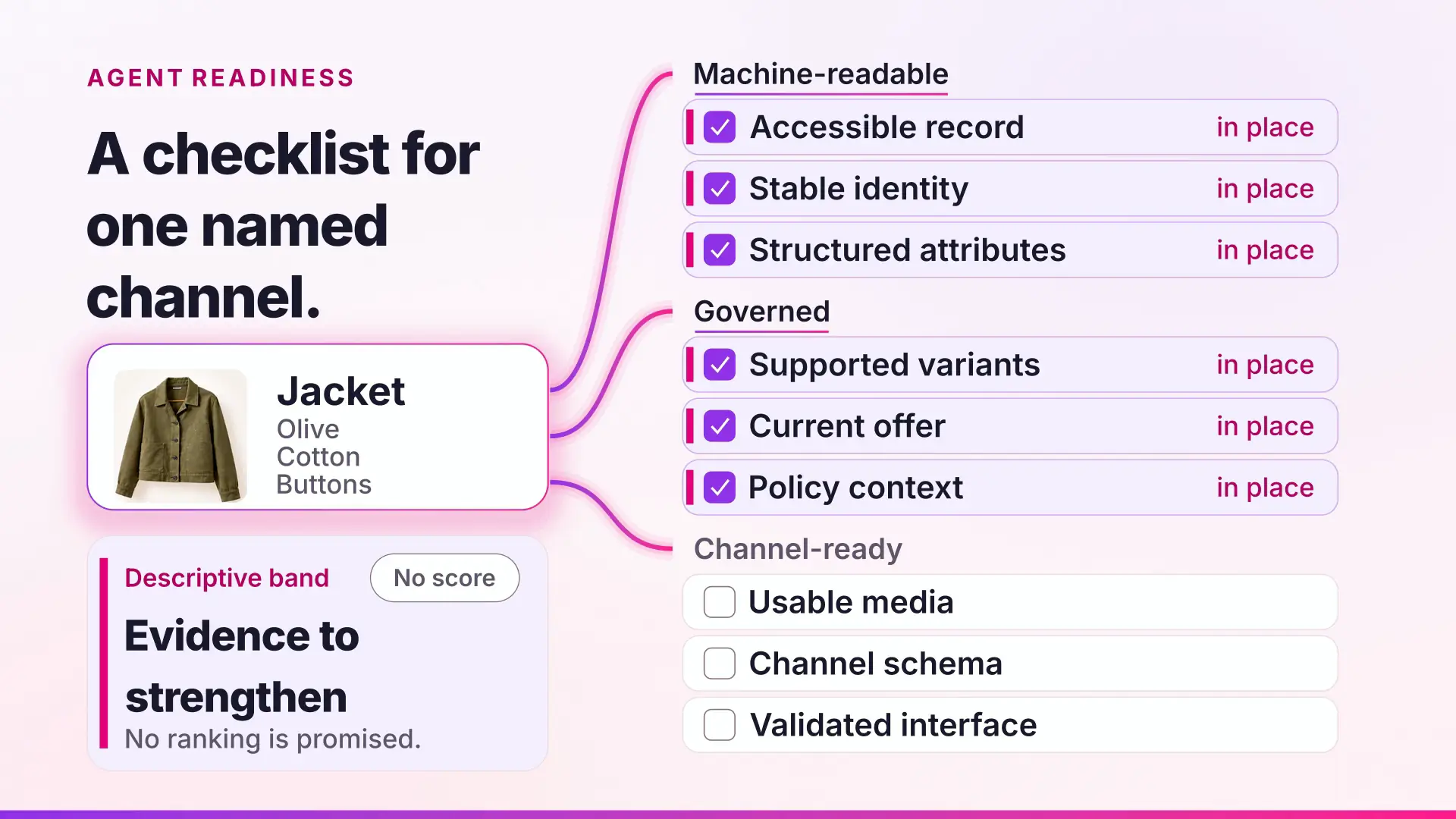
Layers in Youzu terms
Where catalog work helps.
Each layer, its band and the catalog work that supports it. Channel schema and validated interface stay with your team.
| Layer | Band | Where Youzu's catalog work helps | Read more |
|---|---|---|---|
| Accessible record | Machine-readable | Processed products, variants, offers, moderation state and processing status can be read back through the API with filters. | Developers |
| Stable identity | Machine-readable | Products, variants and seller offers are separate records; uncertain matches stay separate and can go to review. | Duplicate detection |
| Structured attributes | Machine-readable | Products map to your category tree; the attributes your category defines are extracted, numbers and yes/no values stay typed, and unsupported values stay empty. | Automatic categorization |
| Supported variants | Governed | Options within one product are variants, kept apart from other products. | Variants and families |
| Current offer | Governed | Each seller's offer is its own record; changed products can be re-sent and the same SKU identifies a later version of an offer. | Offer matching |
| Policy context | Governed | You define versioned moderation rules; a review queue lists flagged products; active rules never change automatically. | Content moderation |
| Usable media | Channel-ready | The Merchant API returns image-check findings with severity, reasons and evidence for 1 to 6 images. | Listing quality |
| Channel schema | Channel-ready | Your team maps your record to one named channel's documented schema. | Your team |
| Validated interface | Channel-ready | Your team validates a sample against that channel. | Your team |
Check against one channel
Name the channel first. Everything else follows from it.
“Agent-ready” only means something against a documented destination. Work from the destination's requirements back into your records.
Step 1 of 4: Name the destination
Step 2 of 4: Map requirements
Step 3 of 4: Sample and inspect
Step 4 of 4: Route the gaps
6 questions before you check
Answer them for one channel. Copy them into your own notes; nothing is sent.
- Which one documented channel are you checking against, and where does it publish its requirements?
- Which fields or attributes does it require, and which are optional?
- For each required field, where does the value live today: a source system, a rule, an image, or nowhere yet?
- Which records are hard: variants, multi-seller offers, missing attributes?
- Who approves what is sent, and what happens to a record you cannot resolve?
- How will you validate a sample, and who reviews every error?
Questions buyers ask
Agent Readiness is an explainer and checklist for whether product and offer information suits a named machine-facing channel, such as a shopping assistant. It covers 9 layers in 3 bands: machine-readable, governed and channel-ready. It gives no score, and human approval stays with your team.
No. It is an explainer and a self-check on this page, not a product feature or a service, and it does not connect to any channel. Youzu's catalog work on categories, attributes, variants, offers and review produces the records that you then check against a channel's published requirements.
No. No ranking or visibility in any assistant is promised, and no one can promise it. Clear, consistent product facts give search engines and shopping assistants better material to work with, which is why the checklist starts with identity, attributes and offers.
No. Youzu does not place orders, take payments or handle returns, and this page does not describe any purchase by an assistant. The work stops at governed, selected product information prepared for a documented destination, with your reviewers keeping the approval gate.
No. You mark the layers you can evidence, and the page shows one of 3 descriptive bands, never a number. Your selection stays in your browser and in the link you choose to copy. The bands describe what is in place today for one named channel and predict no commercial result.
Pick one documented channel, such as a shopping assistant, a product feed or an agent interface that publishes its requirements. Agent-ready only means something against a named destination, so its published requirements become your acceptance criteria and the checklist shows where your records fall short.
Next step
See it with your products.
Bring a sample of your catalog, your listing flow or your shopping idea. We will show you what the results look like on your data.