

Seller's listing
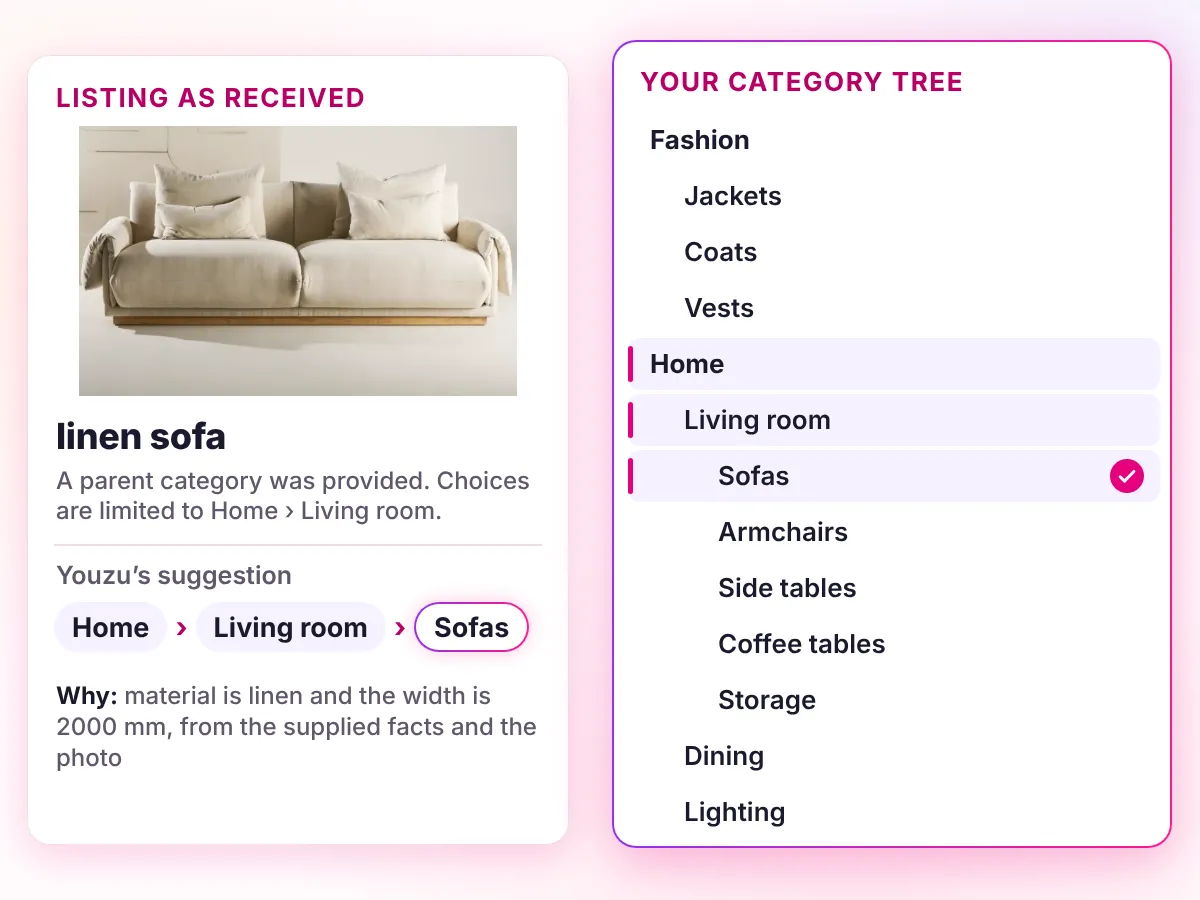
linen sofa
- linen
- 2000 mm
- Home / Misc
A parent category was provided. Choices are limited to Home.
Youzu maps products to your category tree; a category you provide skips inference, and a parent category limits the choice to its descendants. Youzu reads the title, attributes and images to suggest a category, and an unresolved category is left unresolved instead of guessed.
Key points
Try it
Where should this be listed?
Seller's listing
A parent category was provided. Choices are limited to Home.
Example category tree
Try it
Move each product to its category.
Linen sofa

Velvet sofa, navy

Grey 2-seat sofa

Terracotta armchair

Accent chair, plum

Oak coffee table

Oak side table

Plum lounge seat
Home
Living room
Sofas
No product here yet.
Armchairs
No product here yet.
Coffee tables
No product here yet.
Side tables
No product here yet.
Decisions
Your rules, your reviewers, your approval.
| What you send | What Youzu does |
|---|---|
| Category not supplied | Category: inferred. Youzu suggests one from the listing. |
| A parent category supplied | Choices are limited to the parent's descendants. |
| A category supplied | Category: provided. Inference is skipped. |
| Nothing resolves | Category: unresolved. Attribute and description suggestions are skipped, not guessed. |
Automatic categorization assigns each product to a node in your category tree. Youzu reads the title, attributes and images and suggests a category. If you already supply a category, inference is skipped; if you supply a parent, the choice is limited to its descendants. Try the example above to compare your guess with Youzu's suggestion.
The category stays unresolved instead of being guessed. When a category is unresolved, Youzu skips the attribute and description suggestions that depend on it, so a wrong category cannot spread wrong fields. Your team or the seller can then choose a category. The fifth listing in the example shows this case.
Yes. Youzu maps products to your category tree and extracts the attributes your category defines, so it needs both. Send the category tree and attribute definitions with a sample of products. Your taxonomy stays yours, and processed records stay available to you through the API. Book a demo to scope the sample.
Yes. In the Merchant API the suggestions are advisory, and your application decides which category to apply. In a catalog workflow, reviewers can approve or reject enrichment before it is accepted, and the original category stays beside the suggested one. The seller listing assistant page shows the seller side.
Youzu does not publish an accuracy figure. Accuracy depends on how clear your tree is and how much evidence each product carries, so measure it on your own sample against your own labels, with critical errors reported separately. Include thin records and ambiguous titles in the sample. The benchmark page describes the method.
Titles and descriptions can be handled in 1 to 5 of 24 language codes per catalog, and English is required when AI processing is on. Language quality can differ, so check each language you need on your own sample. Name the languages and send a sample for each when you book a demo.